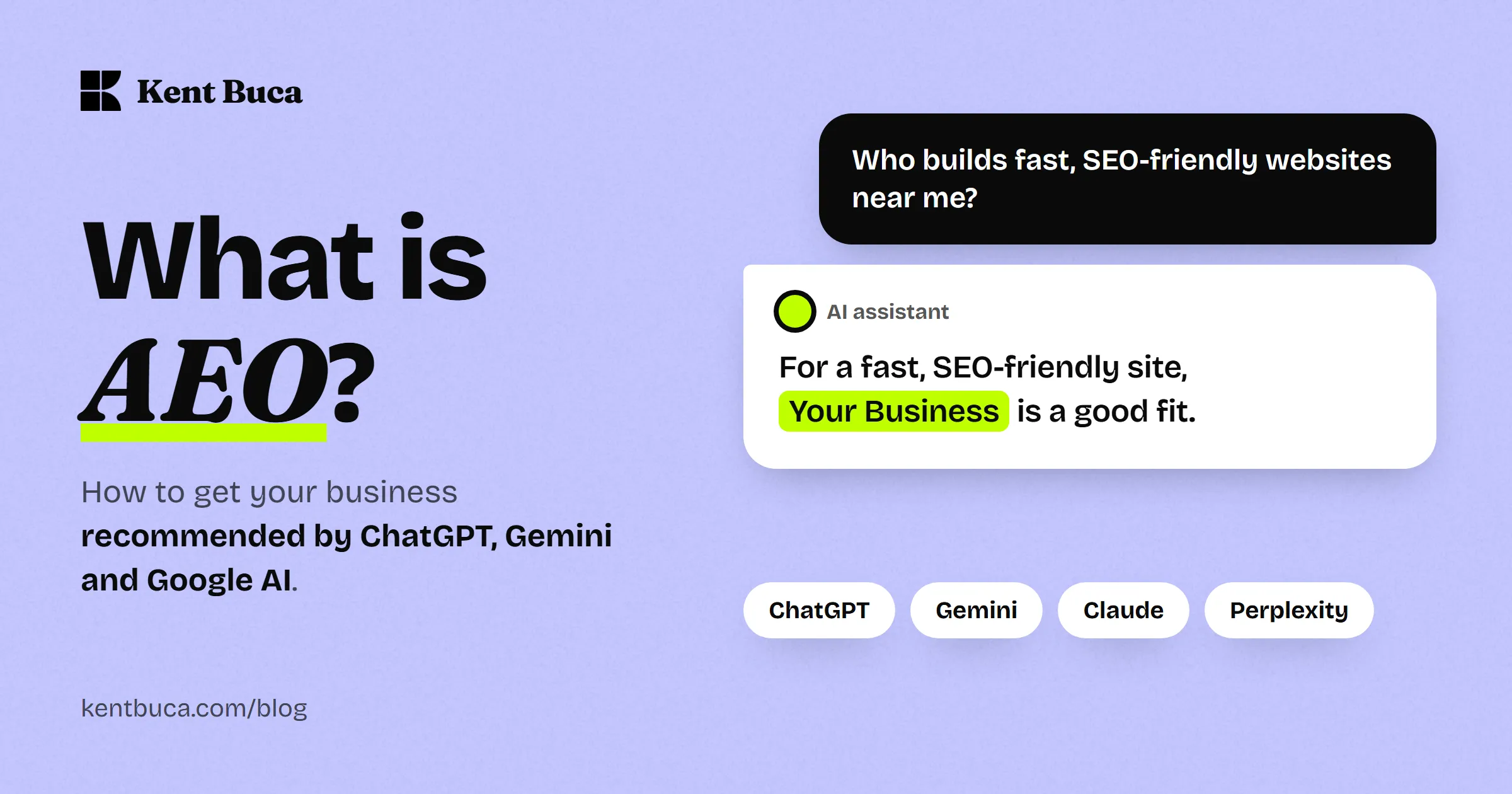
More people now ask an AI assistant instead of scrolling through search results. “What’s a good web developer in Davao?” “Which clinic in Makati does teeth whitening?” The assistant answers in a paragraph, and maybe names a few businesses.
Answer engine optimization, or AEO, is the work of making your business one of the names in that paragraph.
How AI assistants find information
AI tools like ChatGPT, Gemini, Perplexity and Google’s AI Overviews build their answers from information they can access and trust. Depending on the tool and the question, that might include live web search results, pages they crawl directly, and what they learned during training.
You can’t control any of that directly. But you can make your business easy to find, easy to understand and consistent everywhere it appears. That’s the core of AEO.
What actually helps
Answer real questions clearly
Write pages that answer the questions your customers ask, and put the answer first. “Yes, we work with clients across Mindanao” is easier for an AI to use than a paragraph of build-up. FAQ and Q&A pages work well for this, as long as the answers are genuine and useful.
Be specific about who you are
State plainly what you do, where you operate and who you serve, on your homepage and About page. Vague slogans give an AI nothing to repeat. Clear facts do.
Use structured data
Structured data (schema markup) is code that labels the information on your pages: this is a business, this is its service area, these are its services, this is a question and its answer. It helps machines read your site without guessing.
Keep your details consistent across the web
Your business name, services and contact details should match on your website, Google Business Profile, Facebook page and directory listings. When the same facts appear in many places, they’re more likely to be trusted and repeated.
Earn mentions and reviews
Reviews, local news coverage, directory listings and mentions on other sites all help establish that your business is real and well regarded. This is the same reputation work that helps regular SEO.
Let AI crawlers in
Check that your robots.txt file doesn’t block AI crawlers such as GPTBot, ClaudeBot or PerplexityBot, unless you have a reason to. Some sites also publish an llms.txt file, a plain-text summary of the site for AI tools. It’s a newer, still-emerging convention rather than a standard every tool reads, but it’s quick to add.
Microsoft Copilot answers from Bing’s index, so it also helps to tell Bing about changes as soon as you make them. IndexNow does that automatically.
How to tell if it’s working
- Ask the assistants yourself. Try the questions your customers would ask, in ChatGPT, Gemini, Perplexity and Google, and note whether you’re mentioned. Check again every month or so.
- Watch your analytics. Visits from sites like chatgpt.com or perplexity.ai show up as referral traffic in Google Analytics.
- Track your regular SEO too. The two are closely linked. Pages that rank well in Google are more likely to be used in AI answers.
Is AEO different from SEO?
Mostly, it’s SEO with extra emphasis on clarity, structure and consistency. The same work that helps you rank on Google tends to help you appear in AI answers, so nothing you do for AEO is wasted.
If you’d like help, AI Search optimization is one of my core services, and it’s built into every site I make, including this one. Book a free call and I’ll check how AI tools currently describe your business.